web3 / 2026
Syndic — Programmable Settlement Rails for Micro-Remittances
Programmable cross-border settlement infrastructure for micro-remittances, featuring regional liquidity clusters, periodic Solana net reconciliation, four-tier corridor routing, and dual-instance Redis isolation.

Corridor routing paths
4 explicit models (F2F, C2C, C2F, F2C)
Currencies supported
AED, INR, USD + USDC, USDT, SOL
Redis topology
Dual-instance (Core: 6379, Client: 6380)
Monorepo architecture
3 services (NestJS API, Express Settlement, Next.js UI)
01 / The Micro-Remittance Dilemma: Legacy Correspondent Banking
The Micro-Remittance Dilemma: Legacy Correspondent Banking
Legacy correspondent banking infrastructure was architected for institutional wire transfers, not the rapid, small-value payments that characterize modern migrant worker remittances. When a construction worker in Dubai transfers AED 150 ($40) home to family in Kerala, the payment navigates multiple intermediary correspondent banks. Each institution levies fixed handling fees, extracts wide foreign exchange spreads, and enforces pre-funding capital locks. The result is a system where transfer costs consume 5–10% of the principal and delivery takes 2 to 5 business days. Syndic addresses this structural inefficiency by eliminating correspondent hops entirely, providing instantaneous cross-border value transfer at domestic payment speeds.
- Bypasses legacy SWIFT correspondent banking networks and multi-day settlement latency
- Eliminates prohibitive fixed fees that penalize small $10–$50 remittances
- Delivers real-time domestic payment latency (seconds, not days) for senders and receivers
- Mitigates capital lockup by replacing institutional pre-funding with periodic net reconciliation
02 / Decoupled Regional Liquidity & Periodic On-Chain Settlement
Decoupled Regional Liquidity & Periodic On-Chain Settlement
The foundational architectural premise of Syndic is decoupling the consumer payment experience from cross-border capital settlement. Each supported geographic endpoint operates an independent regional liquidity cluster. An outbound payment debits liquidity locally in the sender's jurisdiction, while the destination cluster immediately disburses local fiat to the recipient via domestic rails like Razorpay or local bank transfers. Instead of executing costly, volatile cross-border transactions per payment, the net exposure between the two regional clusters is batched and reconciled periodically on Solana using stablecoin primitives. Batching hundreds of micro-transfers into aggregate net settlements reduces on-chain network costs by up to 90% while preserving cryptographic solvency.
- Regional liquidity clusters execute instant domestic deposits and payouts concurrently
- Net exposure between corridors is aggregated off-chain and settled periodically on Solana
- Leverages stablecoins (USDC/USDT) as a global, neutral settlement abstraction layer
- Periodic net settlement reduces on-chain transaction frequency and overhead by up to 90%
03 / Multi-Corridor Routing Across Fiat & Decentralized Liquidity Rails
Multi-Corridor Routing Across Fiat & Decentralized Liquidity Rails
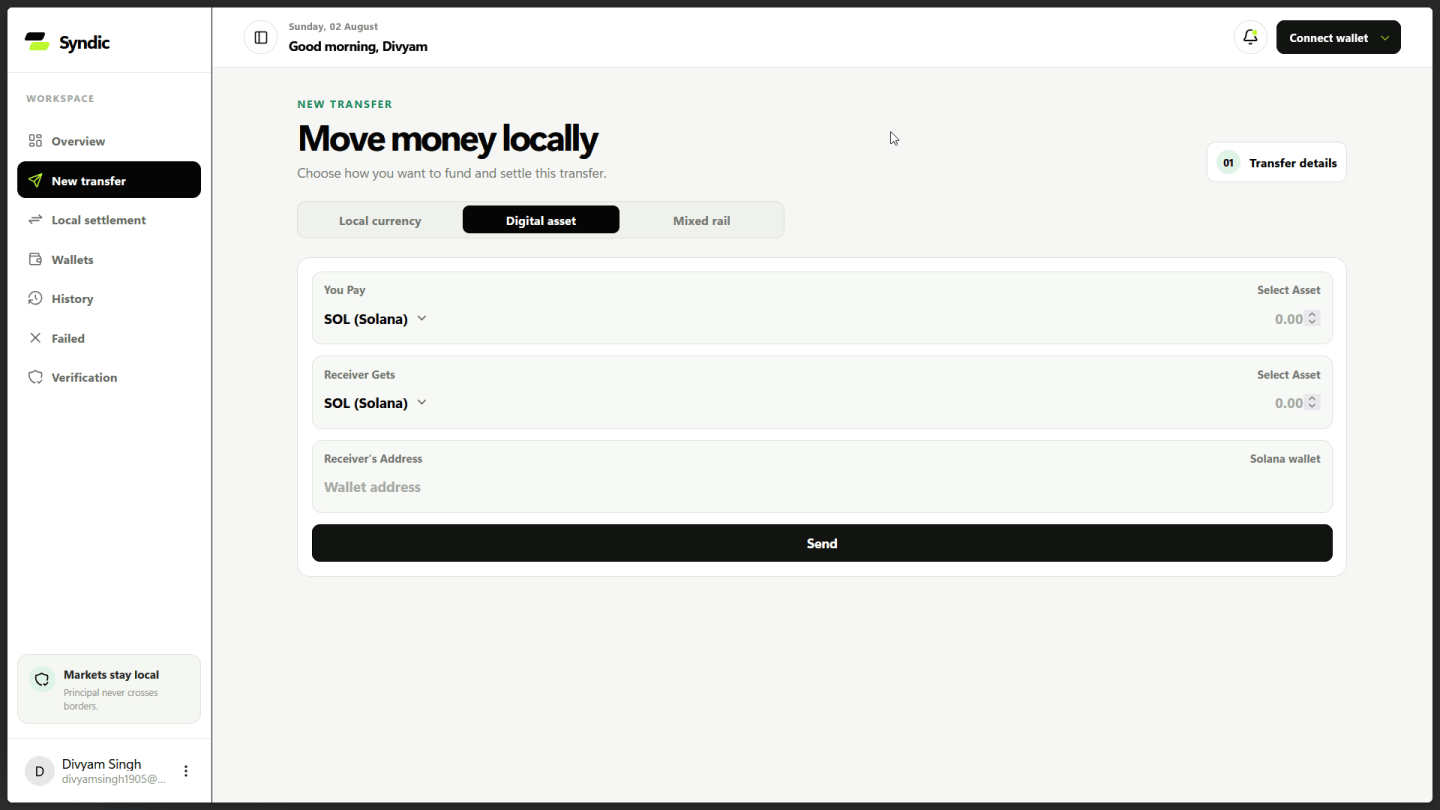
Remittance corridors require dynamic routing across varied financial rails depending on participant preference, jurisdiction, and regulatory access. Syndic models transfers through four explicit relational routing modalities: Fiat-to-Fiat (F2F) for domestic banking rails, Crypto-to-Crypto (C2C) with serialized DEX execution routes (persisting Jupiter swap paths, slippage thresholds, and liquidity sources on Solana), Crypto-to-Fiat (C2F) for stablecoin liquidation through licensed off-ramp partners, and Fiat-to-Crypto (F2C) for programmatic token purchases. Explicit relational typing eliminates polymorphic schema vulnerabilities and guarantees full cryptographic and financial auditability across every corridor.
- Explicit relational modeling for 4 transaction paths: F2F, C2C, C2F, and F2C
- Persists serialized multi-hop Jupiter DEX swap paths and slippage tolerances for deterministic execution
- Integrates Razorpay and licensed fiat gateways for automated domestic deposit collection
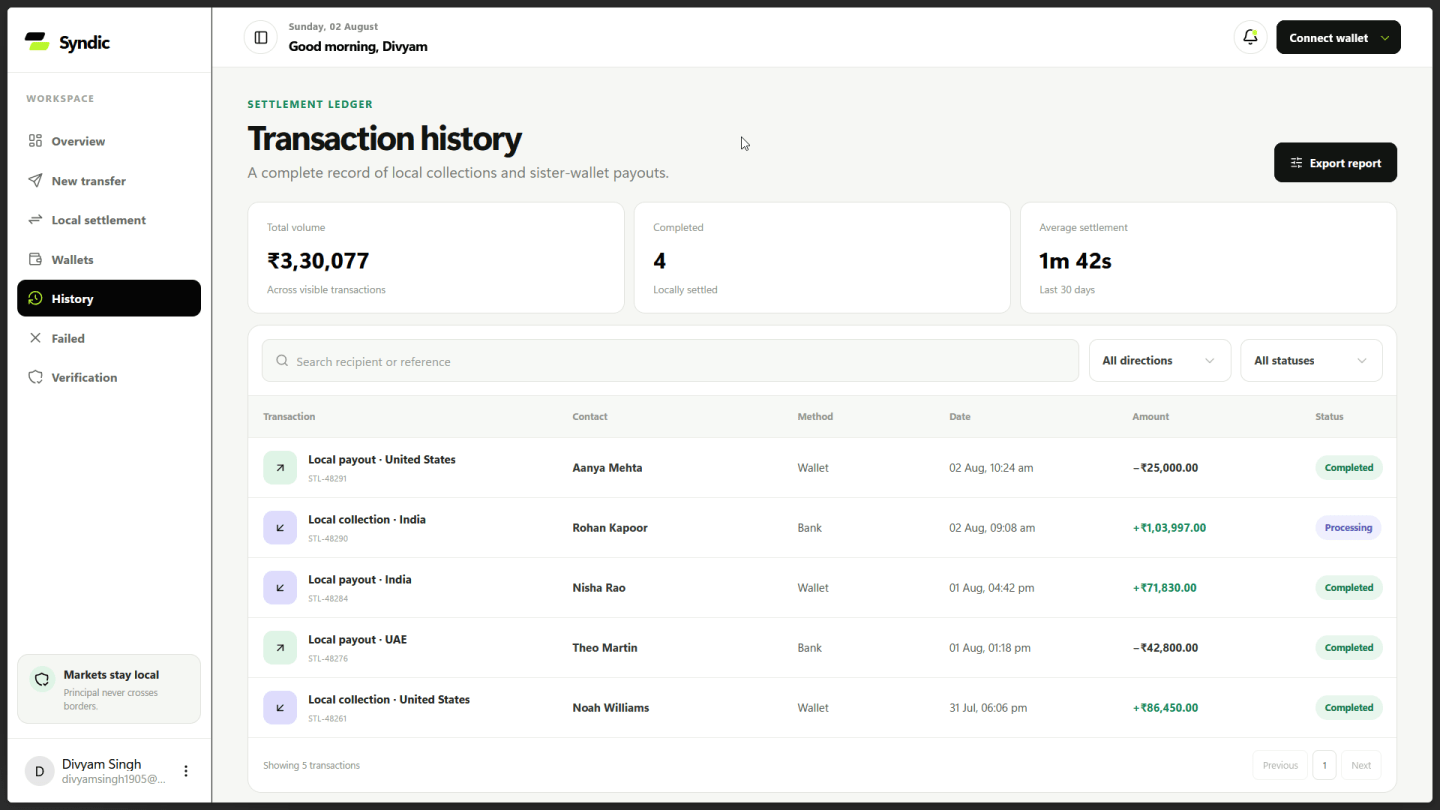
- Maintains immutable audit ledgers linking transactions to verified settlement state records
04 / Dual-Instance Redis Topology: Eliminating Lock & Cache Contention
Dual-Instance Redis Topology: Eliminating Lock & Cache Contention
High-throughput remittance platforms face concurrent operational demands: client dashboard queries generate high-frequency read traffic, while the settlement engine executes high-stakes distributed locks and balance mutations. To prevent noisy-neighbor cache eviction and latency degradation from impacting critical settlement tasks, Syndic deploys a dual-instance Redis architecture. The core instance (antonRedis, port 6379) is strictly isolated for inter-service coordination, distributed concurrency locks, and wallet state transitions. The client instance (clientRedis, port 6380) manages user authentication tokens, rate-limiting counters, and ephemeral UI cache layers. This physical connection separation ensures that client traffic spikes never degrade transaction settlement velocity.
- Core Redis instance (port 6379) dedicated exclusively to distributed locks and wallet mutations
- Client Redis instance (port 6380) isolates user session tokens, rate limiting, and dashboard caching
- Connection-level isolation eliminates noisy-neighbor lock contention during high-volume remittance bursts
- Exported as strongly typed ioredis client abstractions across monorepo workspace packages
05 / Multi-Currency Custodial Ledger & Statutory KYC Compliance
Multi-Currency Custodial Ledger & Statutory KYC Compliance
Cross-border financial rails between India and the UAE demand stringent regulatory compliance and robust multi-currency accounting. The SyndicWallet model maintains floating-point balances partitioned across three supported fiat currencies (totalAED, totalINR, totalUSD) linked directly to verified user profiles. The platform implements an end-to-end statutory compliance pipeline: UserKYC captures Indian PAN and Aadhaar identity numbers alongside document images, progressing through verified KYC state transitions. Transaction authorization requires a separate 6-digit numeric platform security PIN, strictly validated at the API boundary using Zod regex transformations and E.164 phone number formatting.
- Multi-currency custodial ledger partitions balances across AED, INR, and USD accounts
- Statutory Indian and UAE KYC verification links PAN and Aadhaar records with document image proofs
- Zod schema validation enforces 6-digit numeric platform security PINs and E.164 international phone formats
- Turborepo monorepo unites NestJS API, Express settlement engine, and Next.js 15 UI with shared workspace packages
06 / Architecture
System design decisions.
Syndic decouples user-facing transfer latency from cross-border settlement by operating regional liquidity clusters. The transaction engine routes transfers across four distinct paths (Fiat-to-Fiat, Crypto-to-Crypto, Crypto-to-Fiat, and Fiat-to-Crypto). In crypto routes, dynamic Jupiter swap paths and slippage constraints are persisted directly in CryptoToCryptoRoutes.path. Relational balances are tracked across three currencies (totalAED, totalINR, totalUSD) in SyndicWallet. To eliminate contention between settlement operations and user web requests, the infrastructure utilizes a dual-instance Redis configuration (antonRedis on 6379 for core engine state and clientRedis on 6380 for client sessions). Local fiat rails (Razorpay) execute payouts instantly, while cross-border exposure is reconciled periodically on Solana using stablecoins.
07 / Challenges
The hard parts.
Serializing and executing multi-hop DEX swap paths for crypto corridors
Routing crypto transfers across volatile decentralized markets requires executing swap transactions with deterministic price and slippage guarantees. Syndic records the full multi-hop DEX execution route—such as Jupiter routing quotes on Solana—as an immutable JSON payload alongside explicit minimum slippage tolerances and liquidity source metadata, allowing asynchronous worker queues to verify route validity prior to on-chain execution.
Eliminating cache and lock contention across dual workloads
Spikes in user dashboard activity and session verification can exhaust connection pools and introduce latency into backend transaction locking mechanisms. Syndic isolates these workloads across two physically separated Redis instances: clientRedis (port 6380) serves ephemeral frontend tokens and rate counters, while antonRedis (port 6379) executes distributed locks and state transitions without noisy-neighbor interference.
Statutory multi-jurisdiction regulatory and KYC compliance
Operating cross-border financial rails between India and the UAE requires adhering to strict anti-money laundering (AML) and know-your-customer (KYC) statutes. Syndic implements structured UserKYC entities linking verified PAN and Aadhaar identity numbers with tamper-resistant document media, fortified by a required 6-digit platform security PIN enforced at the API schema boundary.
08 / Takeaways
What the build taught me.
- Decoupling consumer-facing domestic transfers from on-chain cross-border settlement allows remittance platforms to deliver instant user experiences while slashing international settlement costs by up to 90% via periodic netting.
- Explicit relational modeling for distinct corridor variants (F2F, C2C, C2F, F2C) with dedicated route entities is significantly more maintainable and auditable than polymorphic tables with nullable attributes.
- Physically isolating Redis instances by operational domain (ephemeral cache vs core coordination lock engine) eliminates noisy-neighbor degradation during high-traffic remittance surges.
- Validating composite regulatory documents alongside numeric authorization PINs at the API schema boundary prevents malformed or non-compliant payloads from reaching backend ledgers.
09 / Stack